About this blog

My photo
Wales, United Kingdom
Documenting one couple's attempts to live a more self-sufficient life.
Showing posts with label Lacto-fermentation. Show all posts

Sunday, 28 February 2016

Fermented veg: Not just sauerkraut

After my early enthusiasm for fermenting all of the vegetables, I settled down to just sauerkraut. However, seeing that carrots were going cheap in the supermarket recently, I bought a second bag and had a go at fermenting those.

Roughly following a recipe that someone shared in a facebook group, I added small quantities of onion and celery as well as a couple of pieces of crystallized stem ginger (the recipe had root ginger, but I had a jar of the sweet kind in the cupboard). There was something else in the recipe, too - I forget what it was, but I didn't have any.

I wanted to be sure that the ginger (grated, and rather sticky) was evenly mixed with the carrot so, instead of my usual method of adding ingredients in turn to a jar and pressing down as I go, I sprinkled salt over the grated carrots in a bowl first, then mixed the ginger through, and added the other vegetables last, and mixed it all up with my hands. Finally, I packed the mixture into a jar and pressed down. It released enough liquid to submerge everything when it was well squashed.


Fermented carrot salad. The stones are used to keep it under the liquid.

After about a week I tried some and really liked it. I'd wondered whether fermenting the sugar out would lose an essential feature of carrotiness and leave it dull and possibly bitter, but not at all. It just tastes like a tangy grated carrot salad, as if I'd added a good vinegar dressing. It's nice on its own, with cheese or cold meat in a sandwich or, less obviously, as a substitute for chopped tomatoes in cheesy pasta. In fact, I'd say this makes a pretty good alternative to tomatoes in salad, which is great, since I've had no success in growing tomatoes. Unfortunately, I haven't done very well growing carrots, either, but at least they're cheap to buy.

Monday, 18 January 2016

Unexpected cheese

I'm sure we've all opened a bottle of milk to find that it's turned to cheese while we weren't looking. Well, this wasn't quite that unexpected, but, well...

We bought some milk that was already at its use-by date, so needed using up quickly. At the same time, I was wondering whether I could come up with any lacto-fermented product that Ian would like, and I put the two together. Whey (from milk) is sometimes used as a starter for sauerkraut, so why not the other way round? I warmed a pint or so of milk and stirred in about a tablespoonful of juice from the sauerkraut. I expected the milk to curdle almost immediately with the acid, but it didn't, so I put in a bowl in a warm-ish place, and left it.

I say left it... I peered at it, stirred it, sniffed it, and tasted it fairly frequently. The smell and taste weren't too off-putting, so I kept it until, after two and a half days, it separated out into curds and whey.


Bowl of milk left on top of the cooker, next to a warm pipe,now separated.

I'd been hoping it might thicken into yoghurt or something similar, but that isn't what I got. I strained out the curds and tasted them. Certainly not yoghurt... not exactly cheese either, but something along those lines. It had a strong tang, so I rinsed the curds under the tap to make them a bit milder, but they're still quite strong. Not necessarily unpleasant, but not what you expect from something that looks like cottage cheese.


Curds, strained and seasoned.

I added a pinch of salt and a tiny bit of finely chopped rosemary for flavour, then variously wrapped and rolled it to squeeze out more of the strong-tasting whey. I left it sitting over the sieve for about half an hour, but it didn't look like it was going to lose any more liquid, so I transferred it to a little plastic pot for the fridge.


This doesn't seem like much for a pint of milk, but hey - cheese!

It holds together reasonably well, but it's still very soft and easily spreadable. It's a ricotta-type cheese, though stronger in flavour. It's not the yoghurt I was hoping for (Ian doesn't like cheese, much) and I'm not sure I'd choose this flavour for cheese, but it was certainly an interesting experiment and the result is far from inedible. I also have a bottle of whey in the fridge, now. I'm not sure what I'm going to do with that.

Saturday, 1 November 2014

Sauerkraut and other fermented things

This may make me sound a little odd, but I really like cabbage. Not when it's been boiled too long and served plain, a la school dinners, but steamed until just tender and served with a little acid of some kind - lemon juice, vinegar, apple sauce, and chutney are all good - it makes an excellent side vegetable. My favourite kind of cabbage is red, with the tightly-formed heads. I'm not sure whether it really tastes any different from white or green, but it's so pretty when it's cut.


Sliced red cabbage

It's hardly surprising that I should like sauerkraut, since this is essentially cabbage in acid, specifically lactic acid. Even better, from the point of view of making it, is that I don't even have to buy the acid myself, since, with a little encouragement, bacteria will make it for me. The process goes like this: I add a layer of finely sliced cabbage to a jar, sprinkle on a little salt, press down with a pestle, and repeat until the jar is full. There are no precise measurements involved, or indeed any measurements at all.

To reduce the chance of mould growing on the top, I weigh down the cabbage with (washed and boiled) beach pebbles, which I sprinkle with more salt then top up with water before closing with an air locked lid. This might sound like overkill, but I get a lot of mould growth. It's all very well saying, Just scrape off the mould and discard the top layer, but if you ferment in relatively small jars, as I do, that top layer can be quite a high proportion of the total.


Stones and extra salt

The other appeal of red cabbage is that the pigment is an indicator, so it displays the acidity. Here are two jars, one freshly filled, one after a couple of weeks of fermentation:


Sauerkraut, before and after. Such pretty colours!

As for the other fermented things, I've come to the conclusion that lactofermentation is not the best treatment for everything. It works well for cabbage, which is why this is a classic, and for unripe sloes, which is totally obscure (I haven't heard of anyone else trying it) but make a good alternative to olives. The important thing to bear in mind is that the fermentation process alters flavours in other ways than just adding acid. To my surprise, it completely destroyed the aniseed flavour of Alexanders. Wild garlic leaves work well, but the result is not a substitute for garlic, it's an entirely new flavour. Samphire kind-of worked, but the result was disappointing. I'll stick to vinegar for preserving this in future. Courgettes were successful, but I found that I don't really want to eat pickled courgette that often. Do you ferment things? Have you come across anything that works really well?

Overall, I've found that lactofermentation is a useful preservation method for some things, but it's not universal in its application. I still think it's magic, though.

Saturday, 12 April 2014

Alexanders

I know I'm well overdue for a gardening post, but first I want to tell you about this foraged plant. In my foraging challenge last year, I tried and failed to find alexanders, though I did find the somewhat similar fennel instead. On Tuesday of this week, Ian and I went for a walk by the sea, from Aberaeron, which is a little further south than our closest bit of coast, at Aberystwyth. Whether the latitude makes a difference, or whether it's just where the plants happened to get established, I don't know, but alexanders grow in great abundance around Aberaeron.

Having had such trouble finding them last year, I couldn't resist picking a bunch, as they were there...


A bunch of flowers, also stems and leaves.

Having conveyed my booty home, I then had to ask myself, What do I do with an armful of alexanders? This is a strongly flavoured vegetable - tasting something like both fennel and celery - so simply eating all that as a side vegetable was a bit unlikely. Some form of preservation - possibly several forms - would be in order.

My first effort was crystallized (candied) stems, following a River Cottage recipe. This is a slow process in which the stems (first cooked to soften) are soaked in sugar solution that is gradually strengthened by pouring it off and boiling off some of the water once a day. After three days of this, the (very sticky) stems are taken out of the syrup and dried. I've put them on the drying rack in the conservatory, though unless we get another sunny day or two (it could happen!) I suspect I'll need to finish them off in a low oven. In the meantime, they're delicious, if very sticky.


I did clean and oil this grid before spreading syrupy things out on it.

Next, I wondered about a pickle. Specifically, I thought I might try a lacto fermentation. The blackcurrant bushes are covered in little leaves, so I picked a few of those to kick start the fermentation. I decided to use the flowers, then after I started, narrowed this to the tight flower buds that look a little like tiny cauliflower florets. I kept things simple and added only salt and blackcurrant leaves, then covered with water that I'd left standing for a bit to let the chlorine evaporate. I'm not at all convinced that's necessary, but it's no bother to fill a jug of water before I start filling the jar, rather than after. I had my doubts about whether this would work, but it had started bubbling by bed time. Blackcurrant leaves are obviously quite potent!


Sadly, the acid lime green is fading in the presence of actual acid

I tried one today and was surprised to find that the dominant flavour is not aniseed, but lactic acid. That not quite such an interesting pickle as I expected, but will probably be quite good. I'll give it a bit longer.

Next I made a drink from the leaves. I considered a liqueur recipe in the River Cottage book, but as I don't really drink liqueurs, passed on that one. I'd picked a handful of Japanese knotweed and wasn't sure what to do with that, either (apart from NOT putting it on the compost heap), so I chucked that and a load of leaves in a saucepan and boiled it until the knotweed was disintegrating, then strained and added sugar. It's not as strong as a cordial - it need 1:2 or 1:3 dilution with water, but it's a very pleasant soft drink.

I still had a big bowlful of leaves that were only slightly limp after sitting on the kitchen counter for three days. My next experiment was jam: I had some plain crab apple jelly that I don't find terribly interesting, so I thought I'd try adding some flavour. Using the syrup from the crystallized stems, I soaked some finely chopped leaves, also including a few sprigs of mint. Some hours later, I heated this up with the apple jelly then when it was all melted together, poured into jars. I didn't boil for long because the flavour of alexanders is much reduced by cooking. That was a mistake, and I had to do it again the next day. I now have a fairly subtly flavoured jelly, which is quite a lot more interesting than the apple jelly I started with.

Finally, I added chopped leaves to a white sauce that I had with fish for dinner this evening. That was disappointing - very bland. Either I should have used a lot more, or the cooking just destroyed all the flavour.

There you have it: Many uses for an armful of alexanders. I'm so glad I found some this year.

Friday, 29 November 2013

Foraged Food Friday: Sloes

Like blackberries, sloes are often picked by people who don't otherwise scour the hedgerows in search of forageable goodies.


Sloes, fruit of the blackthorn tree (Prunus spinosa)

When sloes are someone's only foraged food, they tend to get made into sloe gin. I have a bit of a problem with the concept of sloe gin, in that if I'm buying alcohol to start with, why not just drink it as it is? For my foraged and home-made drinks, I'd rather use sugar and let yeast make the alcohol for me. The sugar still has to be bought, but it's closer to self-sufficient booze than buying booze to start with, I feel. With this in mind, I experimented with sloe and elderberry wine a couple of years ago. This was hugely successful, and I have a batch on the go this year, which I'll file under elderberries and tell you about when it's ready.

The usual advice on picking sloes is to wait until after the first frost. This advice is given for various other things, including parsnips, and I'd heard that it's just an indicator of season, and when they're likely to be ripe. In other words, the frost itself has no effect on the fruit. I had the opportunity to test this theory when I was visiting my sister. I'd picked a few sloes near her house, then a couple of days later we had the first frost of the year, so I went back and picked a few more (not from exactly the same place, but somewhere a little closer, as we were leaving that morning and I didn't have very much time), so I had two samples of sloes to take home with me, picked just a couple of days apart, but before and after the first frost. Once home, I split the earlier sample and put half of it in the freezer overnight, which some people do to mimic the effect of frost.

I did my best to set up a blind taste test. I put my samples in three ramekin dishes and stuck labels to the bottom of the dishes. Over the course of a few hours, I then shuffled the dishes every time I went past them, so that I wouldn't remember which one was which. Unfortunately, it was quite easy to tell them apart. The sloes in the second sample were slightly larger than those in the first, and those that had been in the freezer were considerably messier than those that hadn't. Still, I did my best to ignore these features when I tasted them.


Three samples of sloes: Pre-frost, freezer, and post-frost

The first one I tried had the familiar astringency - you know, the kind that instantly removes all moisture from your mouth and turns your face inside out. Yep, definitely a sloe. The second one... Oh! Where has all the flavour gone? On further testing, there was some flavour - mostly of plums - but no face-turning-inside-out astringency. The third one was somewhere between the two - sharp, but quite palatable. These differences were huge - I felt that my precautions to disguise the samples were entirely unnecessary, but then I didn't know there'd be big differences before I did the test. On looking at the labels, sure enough, the first sample was pre-frost, the second freezer, and the third post-frost. Conclusion: Freezing sloes does indeed reduce the astringency and more freezing (overnight in the freezer) reduces it more.

That said, milder tasting sloes are not necessarily a good thing. Especially in wine making, I value that tannin and balance it with sugar. I'm glad I picked mine early. The sloes I've been eating this week were picked even earlier...

I'd read on the self sufficientish website that unripe sloes can be used as an alternative to olives, if soaked in brine followed by vinegar. Back in early September I spotted a great abundance of unripe sloes growing a long way from where I live, making it impractical to go back for them later in the year. I remembered the olive-substitution, and thought I might as well pick a few and give it a try, seeing as there were so many there. At about the same time, I was starting to experiment with lacto-fermentation and noted the similarity of the salt then acid sequence. How about trying lacto-fermented sloes?

I started with a fairly strong brine - about a tablespoonful of salt in a smallish jarful of sloes in water.


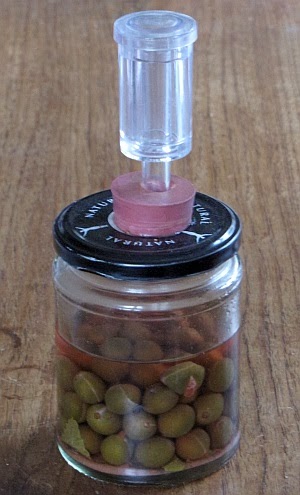
Jar of fermenting sloes. It was fuller to start with - I've eaten some.

After a couple of weeks, I diluted the brine a bit (can't remember whether I took some out or just added water) and added a blackcurrant leaf to introduce the right kind of bacteria, then put an airlock on the jar, as in the photo above. I'm not sure I needed to bother with the airlock, as it fermented so slowly. But... it did ferment. Every day or so I looked at it and saw tiny little bubbles making their way to the top of the jar. I usually gave it a little shake to help them on their way.

A few weeks ago I tasted one of the sloes... Ewww! Way too salty! I removed about half of the liquid (using it later as seasoning in a stew) and topped up with water (tap water left to stand for a bit to let chlorine evaporate. I've come to accept that too much chlorine is not going to be good for lactobacilli. I've no idea whether the chlorine in tap water is too much but it's easy enough to let it evaporate.) After a couple more weeks of slow fermentation I tried again, and... these are really good! They don't taste exactly like olives, of course, but they're similar enough to be an alternative. If I really wanted some olives and only had these in the house, I'd be happy to eat these instead.

Also harvesting this week:
Leeks
Sorrel

Also eating:
Potatoes
Tomatoes
Laver
Blusher mushrooms
Dandelion flower tea
Rowan jelly
Knotweed chutney
Chestnut biscuits (Previous post edited to correct the recipe for these.)
Pickled samphire
Courgette and mint soup (from freezer) with added fresh sorrel

Also drinking:
Hopped ale
Blackcurrant wine
Dandelion and honeysuckle ale

Foraged food challenge summary page here.

Sunday, 17 November 2013

Lacto-fermentation: An upgrade and an experiment

In my last post about lacto-fermentation, I mentioned an improved method for keeping carbon dioxide on top of the vegetables. Here's the blog post where I read about it. Just like wine fermentation, an airlock is used to allow carbon dioxide to escape (pushing the air out ahead of it) without letting oxygen in.

I bought a couple more airlocks (I have a dozen or so, but they're all in use) for 50p each from the health food shop where I buy my home brew stuff then went to the hardware shop in search of rubber seals. I wandered around the shop looking at various bits of rubber that weren't quite what I wanted, but might do, then approached the lady at the counter. I presented an airlock and explained, I'm looking for something that'll seal that into a jar lid. A rubber grommet would be ideal... I don't suppose you have anything suitable? She reached behind her and took a small box marked Grommets from the shelf, and tried several until she was sure she had the right size, then sold them to me for 15p each. I bought four.

With a bit of trial and error, I found the best way of gripping a jar lid for drilling. Trying to grip the edge doesn't work very well, as the edge slips easily if gripped loosely and the lid is flimsy and bends if you grip it more tightly. However, a lid is designed to grip to something - the jar itself - and the jar can be gripped more easily.


I drilled a pilot hole first, then used the flat drill bit to make the correct sized hole.

It wasn't easy getting the grommets into the holes as I'd drilled the holes to be a very tight fit, and also smeared Vaseline into the groove to stop the cut lid going rusty. I did manage to get them in without too much swearing, though, and then the air lock fitted in quite easily.

My next two vegetables for lacto-fermentation - samphire and sloes, of which more in a future post - both had a much higher salt content than the courgettes and beans I'd started with. They both showed signs of fermentation but very, very slowly. I suspected that the bacteria were not thriving in this very salty environment. I decided that the next time I had a suitable opportunity, I'd compare different levels of salt to see whether it made a difference to the speed of fermentation.

The opportunity presented itself when a neighbour gave me a couple of marrows (the same neighbour who'd given me courgettes earlier in the year - he now has a great many marrows). I modified the lids of a couple of large jars that a friend had given me (thanks, Steve!) to make two similar fermenting vessels.

To keep the two jars as similar as possible apart from the salt content, I filled them at the same time: From the heap of marrow pieces, one handful in this jar, one handful in that jar. After each layer of marrow, I sprinkled in salt: One pinch per layer in one jar, three pinches per layer in the other jar. This is still quite a lot less salty than the samphire and sloes, but I don't want my marrows that salty. Comparing three pinches with one pinch should give a clear difference in salt content, even allowing for variations in pinch size (which shouldn't be systematic, in any case). I pressed down the veg as I went and plenty of water was drawn out, so I didn't need to add any to either jar. Instead of blackcurrant leaves, I inoculated the jars with liquid from the fermented courgettes to get the right bacteria in there*.


Two jars of marrow pieces, matched (reasonably) carefully on everything except salt content

I had imagined these air locks bubbling as they do with wine, so that I'd be able to count bubbles per minute or some equivalent. Unfortunately it didn't quite happen like that. The bubbles certainly formed in the jars but with the jars so packed full of marrow, they couldn't rise to the top so they just stayed there. Eventually, of course, enough pressure built up that something had to give. What gave was not gas but liquid, which got a little messy.


More salt is currently in the lead

At this stage the 'three pinch' jar was looking distinctly more active than the lower salt jar. I started to worry that I hadn't matched them adequately and had overfilled the 'three pinch' jar, which was why it was overflowing. Although I was reluctant to break the air locks, I opened both jars to push the veg down. There was no sign that I'd overfilled the higher salt jar; in fact, having overflowed, it now had less liquid than the other one. I spooned a little liquid out of the 'one pinch' jar to compensate, and resealed the lids.

After that nothing much happened for a few days because the temperature's quite a bit cooler than it was in the summer. I put both jars on top of the cooker for a bit to encourage some action and again, it was the 'three pinch' jar that lifted its cap. Things continued in this vein for a couple more weeks, until I decided that it must be time to open the jars and taste the results of my experiment. At this point another difference became apparent.


More salt still winning

I had noticed some mould forming at the top of the jars (or is it yeast? Either way, it doesn't smell very nice), and it's not very surprising that there's more in the lower-salt jar. I scooped out all of the mouldy marrow pieces (rather more from the lower-salt jar) and tasted the fermented marrow. Both jars tasted OK - the only difference was that the more-salt one was... saltier. A bit too salty for my taste, actually, so I'm glad I didn't try a higher concentration of salt for the experiment - I would have ended up with a whole jar full that I didn't want to eat. I couldn't detect any difference in acidity, which surprised me, given the apparent differences in fermentation activity, but perhaps I just couldn't tell over the saltiness.

The presence of mould indicates that the upgrade wasn't entirely successful. That space at the top was supposed to fill up with carbon dioxide so the mould wouldn't grow there (unless of course it's yeast, which can grow anaerobically, in which case pushing out the oxygen wouldn't help). The fact that the bubbles were getting stuck was a sign that things weren't going entirely to plan. I wonder if I need a little more liquid per vegetable solid, or maybe I just need to cut the pieces smaller so it's easier for the bubbles to find a way through. Either way, I don't want a stack of solid pieces that trap the bubbles when they form. Probably.

Conclusion: Three pinches of salt per layer appear to provide a better environment for fermentation than one pinch per layer, though there was no obvious difference in flavour apart from the salt itself, which favoured the less-salt jar.

You'll notice that I don't generalise to 'more salt is better for fermentation' which you might think is a cop-out just because the results didn't go the way I predicted, but there is a reason: From some reading I did at the same time as running this experiment, I learnt that whilst salt is generally bad for bacteria (which is why salting is an effective method of preserving food) lacto-bacili are more resistant to salt than most. The reason for adding salt here is to kill off the bacteria that we don't want, leaving no competition for the ones we do want. If we add too much salt we'll kill off our friendly bacteria as well.

There is an optimum level of salt and it appears to be closer to three pinches per layer than one pinch per layer of marrow. It's still possible that my samphire and sloes had too much salt, but this experiment didn't really address that question because I didn't include such high levels of salt. You could legitimately say that this is a weakness of my experimental design.

---

* Some people believe that this method gives an inferior result, as what you really want is the progression of microbes that occur naturally, to give the full complexity of flavour, not just the one that comes in at the end and makes the acid. Others say it's hard to tell the difference. I don't think I'm that fussy, at least not at this stage.

Thursday, 5 September 2013

Lacto-fermented courgettes: An update

A couple of weeks ago, I told you about my first attempts at lacto-fermentation, with a promise to tell you more in a few months. Well, um, it's not a few months yet, but here's an update anyway.

Both jars of veg bubbled away happily, with the courgettes being particularly vigorous. As the bubbles formed, of course they headed for the surface, and if there happened to be a piece of veg in the way, they tried to take that with them. Thus, veg that had been under the surface to start with headed out into fresh air. This is a common problem, and I'd read many suggested solutions for weighting the veg down, from clean rocks to smaller jars to bags of water. The only idea I could see that would fit through the neck of the jar and still hold down the veg at the edges was the plastic bag of water (or marbles), and I'm not terribly keen on leaving plastic in contact with the food for a long time.*

Without a weight, other alternatives include pushing the veg back down into the water from time to time, or leaving it well alone and relying on the carbon dioxide (formed by the fermentation) to exclude oxygen at the surface. With a simple, loosely-closed lid arrangement, I didn't have much confidence in the carbon dioxide staying put** so I went for the pushing-down option, aware that every time I did it I risked contaminating my ferment. The real reason was that I couldn't leave it alone!

Sure enough, a white film formed on the surface:


Beginnings of mould on the surface of fermented courgettes

People who use this basic method of fermentation are usually quite happy to scoop the mould off the top before taking out their pickled vegetables. I can go along with this - it's my usual approach to mould, in any case. I was a little concerned about the white substance appearing lower down in the jar, though. Surely mould couldn't be growing there?


Quite a lot of white stuff in there

Searching for information on this, I eventually found the Wild Fermentation forum (tip: Include Forum in your search terms if you have a question like this) which assured me (and the questioner there) that this is fine - in fact it's a good sign. That white stuff is the bacteria we want in there (well, dead ones, anyway). So that's OK then.

I first tasted the courgettes at about three days after starting and they were definitely tangy, but a bit odd. Since I now have signs of mould, I've decided to eat up my courgettes (scooping off the white film every time) rather than leave the mould to grow. Now, at two weeks, the flavour is delicious, bit like pickled gherkins (I think - it's a long time since I tried any). The texture is good, too - quite firm, with a bit of a crunch. I'd read about this, but it was still surprising, especially as courgettes are a soft vegetable, and I'd squished them when I put them in the jar.

In spite of the mould, this is definitely a success. I'd like to persevere with this - now I just need a surplus of veg.

---

* I'm not paranoid about plastic and food, but I do bear in mind that some plastics degrade over time and that food-grade plastics are tested for safety in certain situations. For a plastic bag, this might or might not include sitting in a salty, acidic environment for several months. I don't know, so I'm wary. On the other hand, any potential harm caused by the plastic might be less bad than potential harm caused by the mould that it would have prevented. Again, I don't know.

** But I did come across instructions for improving on this arrangement, which I plan to try, so I'll tell you about that when I've done it.

Wednesday, 21 August 2013

Experiments with lacto-fermentation

I'm fascinated by traditional methods of food preservation, from pre-freezer days. I grew up thinking* that winter food was all dried, or heavily salted, or both, and pretty grim in any case. As I've learnt more, I've come to appreciate that it probably wasn't grim at all, and in some cases preservation actually enhances food. Alcohol is an obvious, if debatable, example, and there's another kind of fermentation that's been marginal for many years, but may now be making a comeback.

In the same way that yeast converts sugars into alcohol, lactobacilli bacteria convert sugars into lactic acid, which then preserves the food. After an era of, Kill all the microbes! we're now more familiar with the idea that some bacteria are friendly and are increasingly eating foods such as live yoghurt and lacto-fermented live pickles. Indeed, many health claims are made for these foods. I can't be bothered to investigate these claims thoroughly, but even if these pickles are no better for us than vinegar-based pickles I still think they're worth making. After all, if I can get the acid from fermentation then I don't have to buy it!

In spite of my interest in this topic, I've never had much call to try it before now, as I've never managed to grow anything resembling a glut of vegetables. This year, though, I have my neighbour's courgettes at the same time as French beans and broad beans in my own garden. I don't think either courgettes or French beans are particularly good frozen, so I decided to try fermenting some of each of them, leaving the broad beans to eat fresh. This gave me the perfect excuse to buy a couple of Kilner jars that I happened to spot in the supermarket.

I won't go into detail - you can find plenty of information online if you look for it - but I found this article helpful. In particular, the information about using blackcurrant leaves as the inoculant - the way of introducing the right bacteria - was valuable. I have blackcurrant leaves! I kept my recipes simple, with fairly small quantities of salt - probably a heaped teaspoonful per half-litre jar - and minimal spices. For the courgettes I added hogweed seeds (recently discovered, and hence my current favourite spice) whilst the beans got just salt and blackcurrant leaves. I sprinkled salt and pressed the veg down in the jars as I filled them, which released almost enough liquid to cover the veg. There were still bits sticking out of the top, so I topped up with a little tap water (ignoring advice about avoiding chlorinated water. I've just dissolved sodium chloride in it, for goodness sake! I'm sure a little more chlorine won't hurt.)


Jars of fermenting veg

I did the courgettes on one day and the beans on the next. As you can see in the photo, there were already bubbles rising in the courgette jar by the time I had the beans packed. Fermentation is happening! They'll sit in my kitchen for a few days with the lids on loosely (to let the gas escape) before going down to the cooler, darker store room. I'm not sure how long I'll need to leave the lids loose - I think I'll be monitoring closely for some time. I understand that these can be eaten in a few days, but that the flavour continues to develop for several months after that. I think I'll leave them a while - the point is, after all, to preserve veg while there's plenty available - and let you know when my patience (or fresh veg) runs out. In the meantime, aren't they pretty?


---

* That strikes me as a curious fact about my childhood. How many people grow up with notions about how food was preserved in the olden days?

Translations for Americans: Courgettes = Zucchini, Broad beans = Fava beans, Kilner jars = Mason jars. At least two of these are probably obvious from the photos.