For some time, I have harboured an ambition to make cheap ice cream. I have made various ice creams from various recipes, and they all tend to involve real cream and possibly eggs too. The result is rich, luxurious, and rather expensive. Since we quite like the cheap stuff we grew up with, I started wondering how to make that at home. What could I use to pad out the expensive ingredients? What do the commercial producers use?
A study of ingredients lists revealed something called carrageenan. What's that, then? A bit of googling gave me the answer: It's seaweed. More precisely, it's derived from seaweed, but it's possible to get an extract without any fancy processing. What I need then, is the right kind of seaweed.
I was delighted, therefore, that Saturday's foraging course included carrageen, otherwise known as Irish Moss. I was even more delighted when I went to the beach a few days later to put my learning into practice, that the first seaweed I spotted and identified was also carrageen, and there was plenty of it. I snipped a few strands into my foraging box, brought them home, and rinsed them thoroughly (always essential with seaweed, to remove sand as well as salt).

Carrageen (Chondrus crispus), also known as Irish Moss, in a rock pool
Having gathered and washed my seaweed, I needed a recipe, or at least some clues about how to use it in ice cream. Googling drew a blank. Many pages made reference to its use in ice cream, but none told me how to do it. What I did find was a traditional Irish pudding made by boiling the seaweed in milk and cooling until set - essentially a blancmange (I haven't had that for years!) or milk jelly. Maybe I could try making that and freezing it, with the usual ice cream-making trick of stirring at intervals as it freezes.
Recipes varied considerably in how much carrageen was required, from 1/8 oz to half a pound per pint of milk. To make matters worse, they mostly used dried carrageen, whereas I had fresh. I'd just have to guess, then. I used this much:

The long pod at the top is vanilla
I added about a pint of milk and heated to just simmering for about 20 min. It needed a lot of stirring to keep it from sticking, which I took to be a good sign. I should probably also mention that there was no hint of seaweed smell; all I could smell was hot milk and vanilla. After 20 min I poured the mixture through a sieve then stirred in a rounded tablespoonful of sugar. I poured a little into a ramekin to set in the fridge, just to see what the traditional pudding was like. The rest went into the freezer, and got stirred every half hour or so throughout the afternoon. That was more frequently than it needed, but I couldn't leave it alone!
First, the traditional pudding:

Carrageen pudding.
I added a little cinnamon - probably should have added it in smaller pieces
Well, it certainly set. Indeed, you could even describe the result as elastic. This wasn't the easiest pudding to get out of the bowl. On the other hand, it was delicious. I feel an investment in jelly moulds coming on.
As for the ice cream...
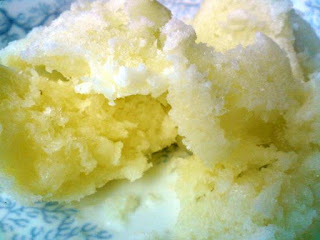
Seaweed ice cream
It tasted good enough when tested
while it was freezing, which isn't very surprising as it was the same stuff as the pudding. It showed similar gelatinous qualities, too, and promised to be a very soft ice cream. This would be a big bonus, as home made ice cream usually needs to be taken out of the freezer some time before serving, to soften. However, the texture wasn't right: In spite of all my stirring, it formed very large ice crystals. It was soft when I served it in the evening, but by lunch time the next day (when I took the photo. I had to have more to get a photo by daylight) it had hardened, so it wasn't even that easy to serve. The large ice crystals puzzled me, as carrageenan - the commercially used extract - is an emulsifier, so I'd have thought it would prevent big crystals forming.
I was a bit disappointed, but I suppose I shouldn't be very surprised that my first experiment didn't come out quite right. This is definitely worth persevering with. The traditional pudding was delicious and the ice cream has potential. Next time I'll use a little less carrageen and maybe try adding an egg. That's still not terribly extravagant. I'll also try using carrageen in place of cornflour to thicken gravy, and perhaps other sauces if that goes well.
Also harvesting this week
Dulse (seaweed - dried for future use)
Rosebay willowherb stems (in salad)
Rosebay willowherb leaves (for ale)
Bay leaves
Wild garlic
Ground elder
Navelwort
Tulip petals
Nettles
Mint
Oregano
Also drinking
Heather ale
Also eating
Garlic
Knotweed chutney (you're supposed to leave it for three months to mature, but I keep thinking of things I want chutney for)
Blackcurrant wine (in stew, so this counts as eating, not drinking)
Foraged food challenge summary page
here.


